🍳Online Cooking Japanese Cuisine 101 Class
For those who have been blown away by the taste of authentic Japanese food
In this class, you will learn how to recreate authentic Japanese home cooking in your own kitchen, in your own country.
We will carefully explain why the flavors are the way they are, logically, not intuitively!
🥣 The Curriculum
-
Ryota's Lab 🧪
The Thermodynamics of Eggs
Why does the yolk set at 65°C while the white needs 80°C? Ryota will teach you the "Two-Stage Pouring Method" to achieve that silky, restaurant-quality texture without a thermometer.
-
Shunta's Story 🏯
The "Parent & Child" Tale
Discover the story of Tamahide, the restaurant that invented this dish in 1891. Learn why it’s called "Parent & Child" (a bit dark, isn't it?) and how it became the soul food of busy Tokyo workers.
-
Technique 🔪
The Art of "Sogigiri"
Learn how to slice chicken against the grain to maximize surface area for flavor absorption. This simple cut changes everything.
🧪 The Value We Provide
The Problem
You’ve graduated from the trial class, and you have the ingredients—perhaps even our JKB Dashi Packs. But when you stand alone in your kitchen, the "Wall of Reproducibility" hits. You feel the anxiety of not knowing the exact heat or timing, and the fear of wasting high-quality ingredients on a "failed" dish. You want to cook authentic Japanese food, but you don't want to just mimic a recipe—you want to understand the "Why" behind it.
The Solution
Our Monthly Masterclass is designed to turn your cooking from a "one-time event" into a lifelong "habit". In this 90-minute deep dive, we move beyond simple instructions to give you "Cultural Resolution".
The Guarantee
The "Lifetime Skill" Guarantee: If you feel the scientific techniques taught (like the "Two-Stage Pouring Method") don't immediately improve your cooking reproducibility, we offer a one-on-one 15-minute follow-up clinic to fix your technique.
The Authenticity Guarantee: We promise to provide the historical and scientific depth that makes you feel like a true insider of Japanese culture, not just a tourist in the kitchen.
👫Reviews
-
Y.O
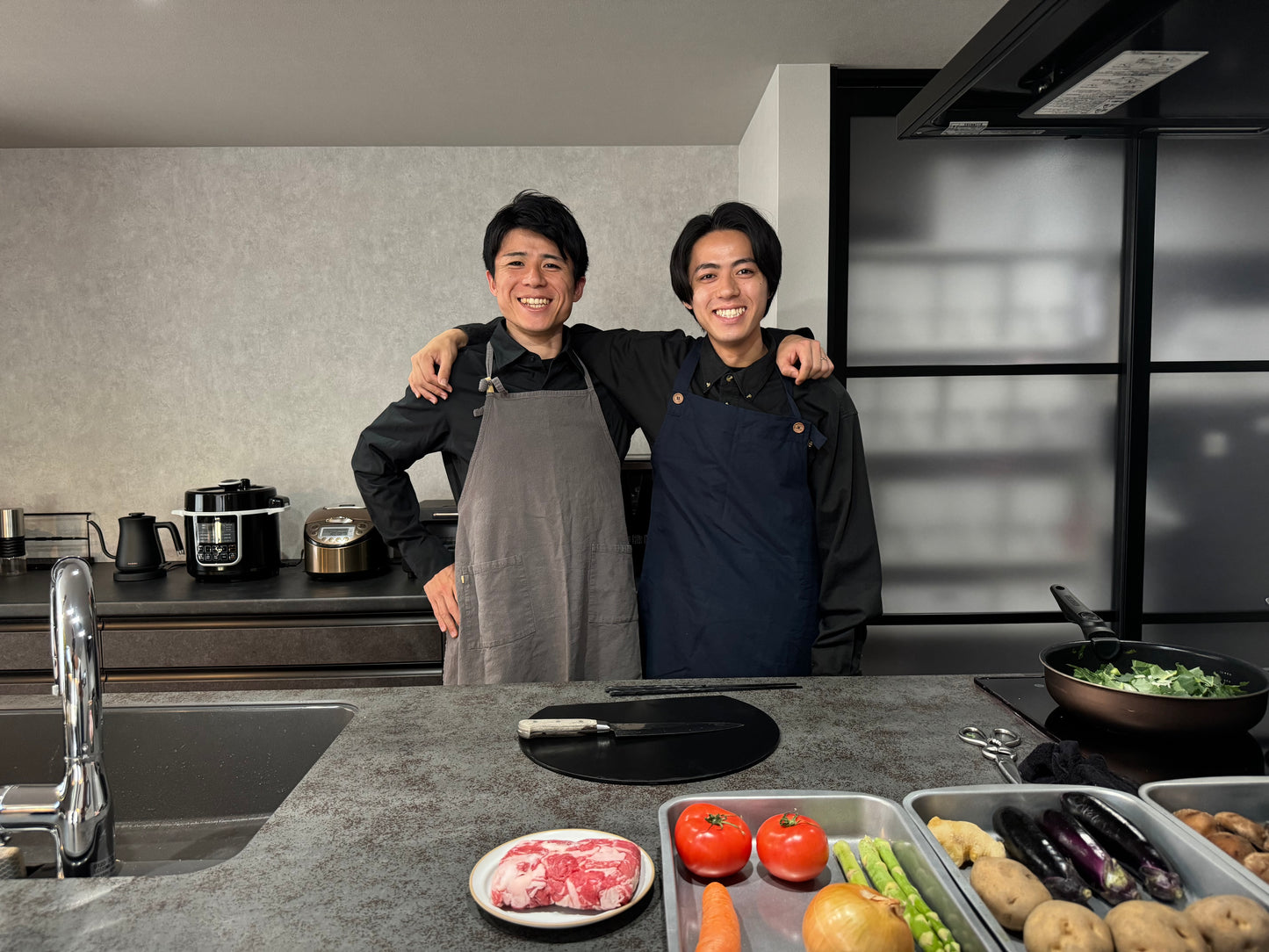
The brother instructors are very friendly, and I can learn enjoyably in a welcoming atmosphere. Because it's a small class, I could ask questions easily and get my doubts cleared...
Y.O
The brother instructors are very friendly, and I can learn enjoyably in a welcoming atmosphere. Because it's a small class, I could ask questions easily and get my doubts cleared...
-
T.O
I thought Japanese cooking was difficult, but the brothers' explanations were clear, and it was really easy to make! I was surprised that I could get an authentic taste using...
T.O
I thought Japanese cooking was difficult, but the brothers' explanations were clear, and it was really easy to make! I was surprised that I could get an authentic taste using...
🛒 Prepare These Items (From Your Local Store)
Lesson Flow
0-15 Min: Welcome & The "Parent & Child" Tale
Shunta sets the stage. Learn the origin of Oyakodon at Tamahide in 1891 and why it became Tokyo’s ultimate soul food.
15-35 Min: Prep & The Art of "Sogigiri"
We prepare the ingredients together. Master the diagonal slicing technique to maximize flavor absorption and ensure the chicken stays tender.
35-65 Min: Ryota’s Lab – The Thermodynamics of Eggs
The core of the class. Ryota explains the science of protein coagulation. We execute the "Two-Stage Pouring Method" to achieve that professional, runny-yet-set texture.
65-90 Min: Tasting & Mindset Q&A
We eat together! Shunta discusses the etiquette and "spirit" of the meal, while Ryota answers final technical questions to ensure you can repeat this at home tomorrow.
Need Ingredients
Chicken Thigh (150-200g): Skin on or off, depending on your preference.
Eggs (2-3 large): Best used at room temperature to achieve that signature "silky" texture.
Onion (1/4 piece): Thinly sliced.
Steamed Rice (1 bowl): Please have this ready before the session begins!
Need Cookware
Dashi Stock (100ml): Use JKB Dashi Packs or your favorite homemade dashi.
Soy Sauce (1.5 tbsp): Regular (Koikuchi) soy sauce is recommended.
Mirin (1.5 tbsp): If you don't have mirin, substitute with 1.5 tbsp water + 1 tsp sugar.
Sugar (1/2 tbsp): Feel free to adjust based on your preferred level of sweetness.
🚦 Not Sure Yet? Choose Your Path
Option A: Talk to Us First (Free)
"I don't have Dashi yet."
"Is my kitchen ready?"
If you have any questions, book a quick chat with us.
>> Book "15-Min Casual Chat"
Option B: Join the Community (Free)
Want to see what other students are cooking? Join our Facebook Group.
>> Join "Japanese Kitchen Family"
Option C: Start the Experiment ($10)
Ready to be shocked?
>> Book your Trial Lesson